ON THE TRAIL WITH AHD
Greece 3. Delphi: From Python to Pythia

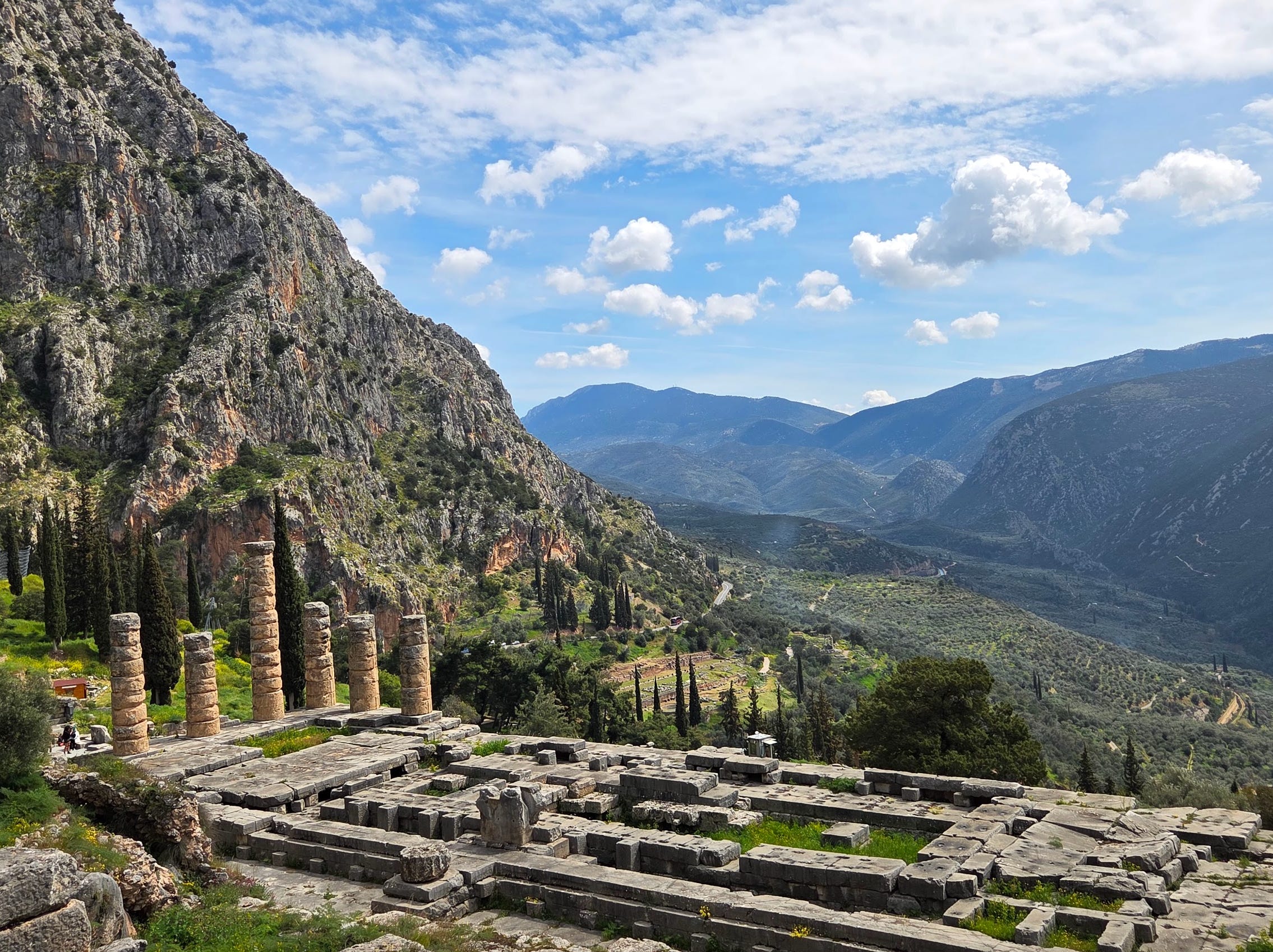
Temple of Apollo on Mount Parnassus from which the Oracle Spoke
In ancient Greek society women were monsters or goddesses—Circe, Medusa, Athena, Hera. As ordinary women, they were non-citizens, invisible, except the Spartan women who turned a farmer’s sickle into a warrior’s weapon.
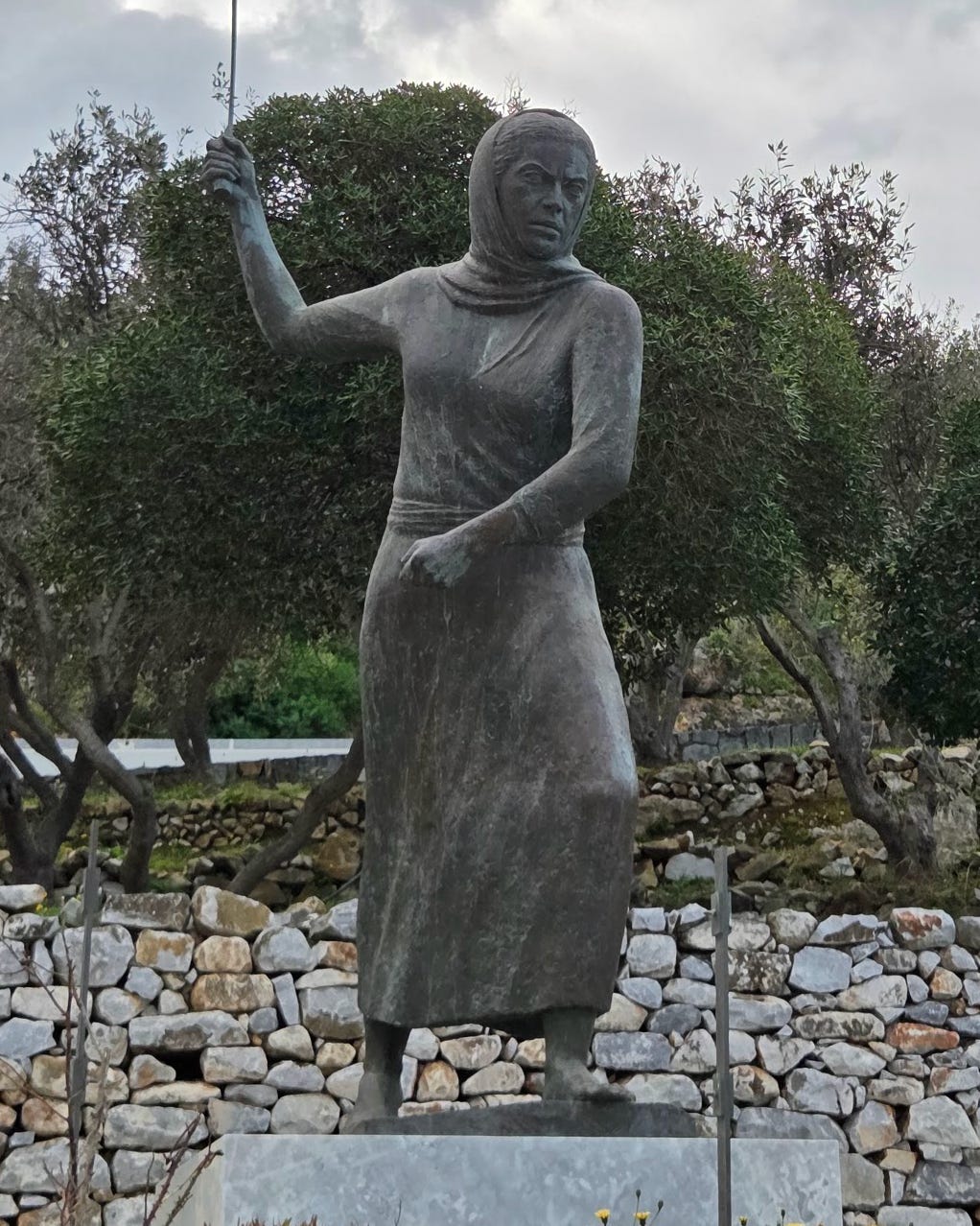
Spartan Warrior, outside the Diros Cave, Peloponnesian Peninsula, Greece
So what are we to make of Pythia, the oracle priestess of Delphi, who sat over a crevice in the earth inhaling ethylene fumes and giving out prophecies said to be transliterated from Apollo himself through the voice of a woman on a natural high. What is it we want from such a site, we who are deaf to Earth’s voice and bereft of the panoply of gods to whom people for millennia could turn for comfort and counsel?
The oracle’s lineage is long. One version of the story says that when Apollo shot his first arrow he killed the serpent Python who guarded the sanctuary of Mother Earth at Delphi. More than a serpent, the victim was the son of Gaia. To atone for the slaying Apollo exiled himself and lived for eight years tending flocks in Thessaly. The murder marks the hard-won end of the old religion of Mother Earth and the start of a new religion with fourteen Olympian gods and goddesses—plus another 3000 minor gods. And it marks the beginning of a ritual of purification and atonement after a homicide rather than bloody retaliation. Greek scholar Ionna K. Constantinou writes that Apollo’s voluntary self-punishment as the guilty person “betokened the awakening of a moral sense, a first step towards the humanization of justice.” Self-responsibility and justice remained keystones to the Oracle’s teachings.
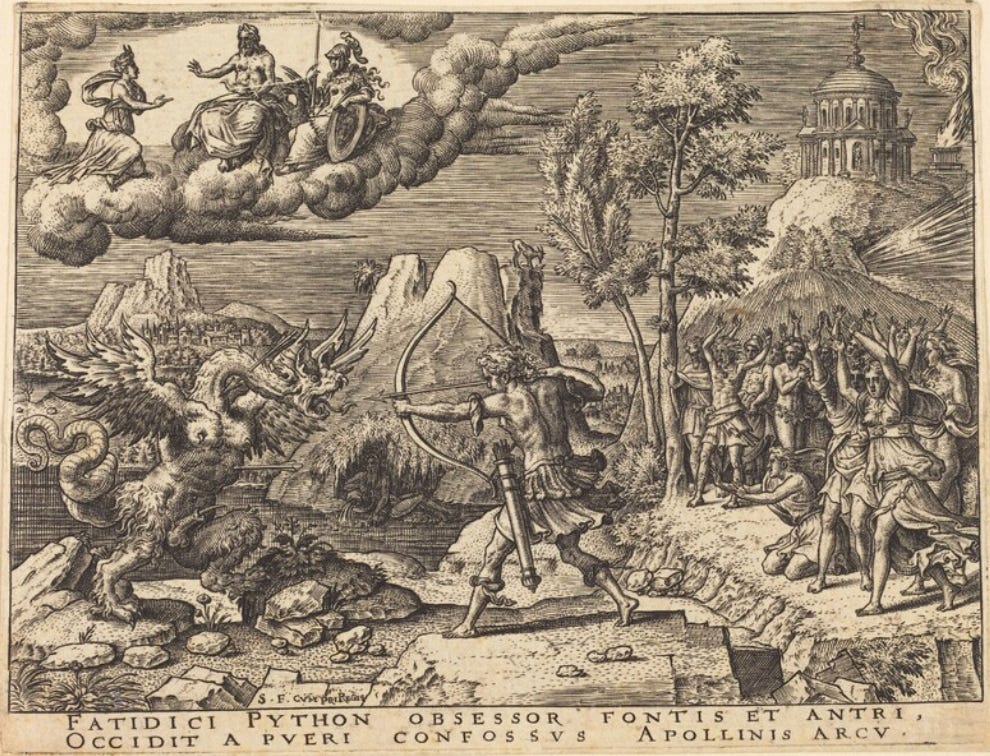
Etienne DeLaune, French artist, 15181586, National Gallery of Art
Apollo named his priestess Pythia. His temple was built atop the crevice that had been Pytho’s lair, just as in Mexico the Spanish friars built their sanctuaries on sites holy to indigenous religions. The place remains holy and becomes instrumental in religious conversion.
In truth, there were many Pythias, the rituals practiced for over 1,000 years. Sometimes divinations were in such demand that three Pythias served at one time. Spiritual preparation for consulting the oracle included purification at the Castalian spring, paying the ritual fee of a honey cake, and making an animal sacrifice, usually a healthy goat, aspersions of its blood sprinkled at the temple and its meat fed to the hungry. The supplicant remained outside the temple, their question delivered by the priests who gathered around Pythia. What was their role and what was hers? Was she in truth a seer and the priests her messengers? Or was she a tool of their patriarchal power, speaking intoxicated gibberish that the priests interpreted to suit their aims? Or were they equal partners in divination? The questions have not been answered in two thousand years. In any case, the Pythias became women of vast influence.
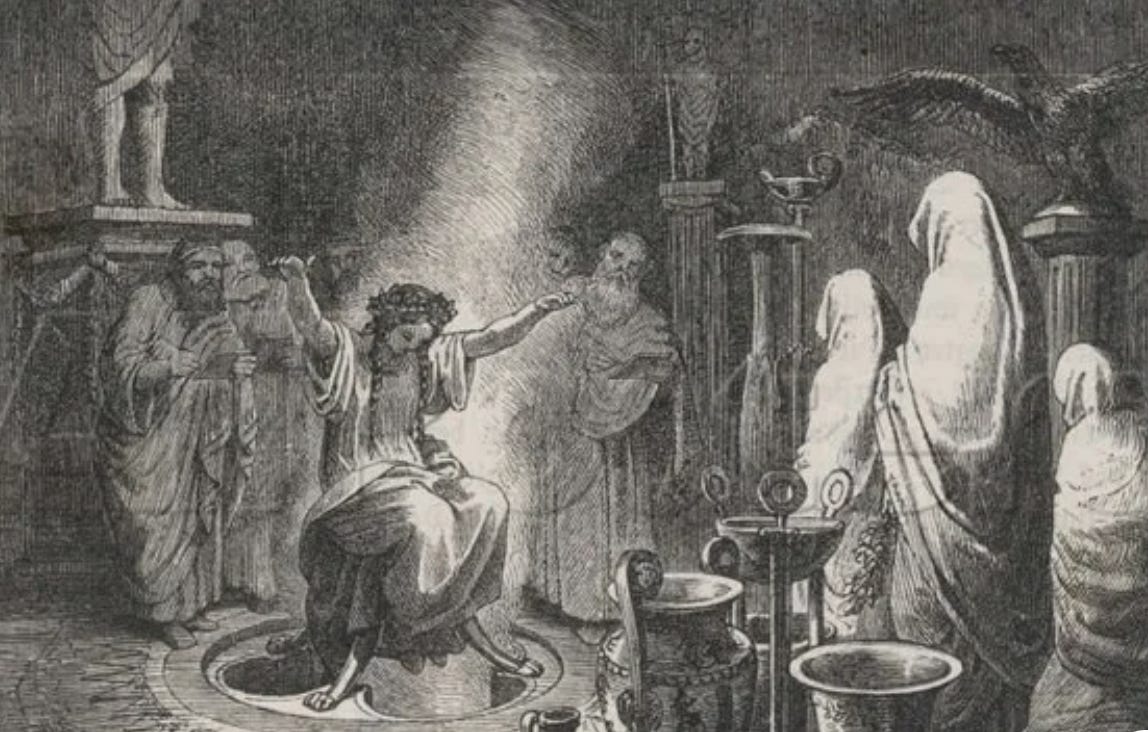
“The Oracle of Delphi Entranced,” wood engraving by Heinrich Leutemann, 1880
Requests ranged them the personal to matters of state: from Tinder to the Council on Foreign Relations. Pythia’s words were cryptic enough to let the supplicants hear what they wanted to hear. Plutarch served as senior priest at Delphi for many years and wrote three major philosophical dialogues dedicated to the oracle and temple. His reports make clear how useful ambiguity was in protecting the oracle’s authority.
He tells of Croesus, the wealthy king of Lydia in the 6th century BCE, who ruled over an enormous kingdom. He consulted the oracle before launching a war against Cyrus the Great of Persia. The Pythia answered that if Croesus crossed the Halys River, he would destroy a great empire. Croesus took this as a guaranteed victory.
He amassed armies, crossed the boundary between his territory and Persia and marched confidently into battle. The Persians crushed his forces. Cyrus captured Croesus, burned his capital at Sardis, and annexed Lydia into the Persian Empire. The great empire destroyed was Croesus’s own.
Centuries after Greece’s heyday, Roman emperors consulted Delphi. Nero visited in 67 CE. According to ancient historian Suetonius, the Pythia warned Nero that the number 73 marked his doom. Nero interpreted this to mean he would reign until age 73.
He left satisfied, continuing his tour where he competed in chariot races and musical contests. The prophecy meant something entirely different. In 68 CE, Galba, age 73, led a successful revolt. The Senate declared Nero an enemy of the state. Facing execution, Nero committed suicide at age 30, having ruled only 14 years. The number referred not to Nero’s age but his successor’s.
In 362 CE, shortly before Christianity became the Roman Empire’s dominant religion, the Roman Emperor Julian sent an ambassador to Delphi. The Oracle gave her final response:
"Tell the king, the fair-wrought house has fallen. No shelter has Apollo, nor sacred laurel leaves. The fountains now are silent; the voice is stilled."
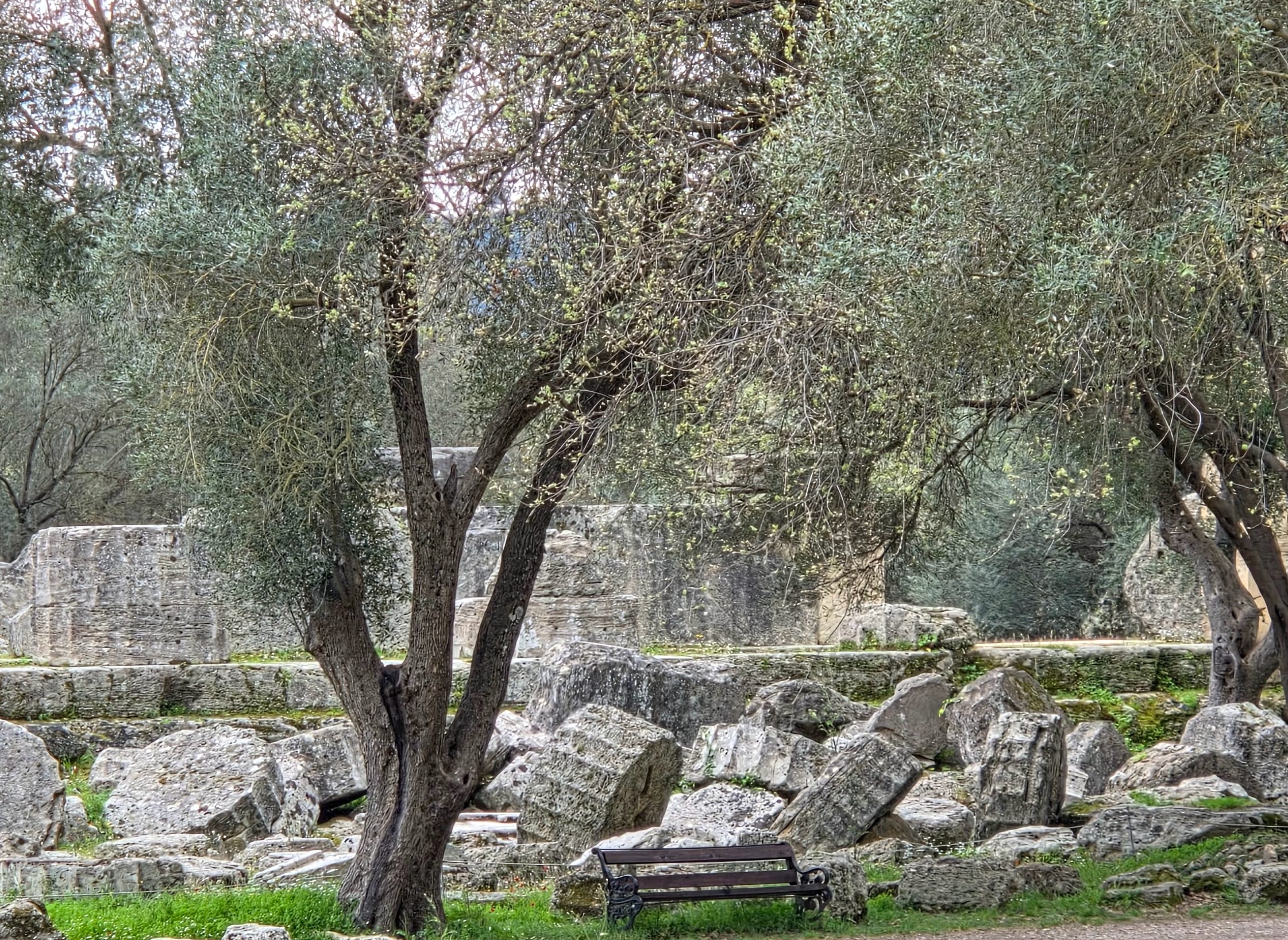
Why am I drawn to these ancient sites in ruin? I love the way art holds religious feeling even after the religion is gone. I love the hunger for religious feeling more than any organized religion. When we took a small boat trip into the Diros Cave, I wondered what the ancient world would have made of stalagmites and stalactites, the weeping Earth, her tears hardened into beautiful forms. Do not forget me, she prays. I am the underworld of stone that hoards the mineral wealth you crave. I am what maintains the living earth as a household of planetary vitality. If the ancients knew the caves, paddled a reed boat into its snaking caverns—thirty kilometers worth—they would have seen them without the strand of electric lights that guide us but in darkness, their little pitch lamps revealing so little of the splendor. It must have felt like a passage into a deep eternity. Indeed, the Underworld.
Bless them for their wisdom and curiosity and courage. We now stretch to regain a faith in the future that they dwelled within. The gods might fuck with them, but they also demanded justice. And what is faith that dwells not in the house of justice but another misread prophecy?
This will be my last of three posts about my travels this spring around the Peloponnesian Peninsula. I’m finishing this post as I sit in my summer place in the village of Castalia on Grand Manan Island. Some of the island’s settlers were very well-read. Up next will be summer dispatches from the Bay of Fundy.
BUT NEWS: I am happy to celebrate that the wonderful Nautilus magazine has awarded my anthology THE GIFT OF ANIMALS their Gold Award in Poetry. Yes, indeed, BETTER BOOKS FOR A BETTER WORLD! Available in all the usual places.